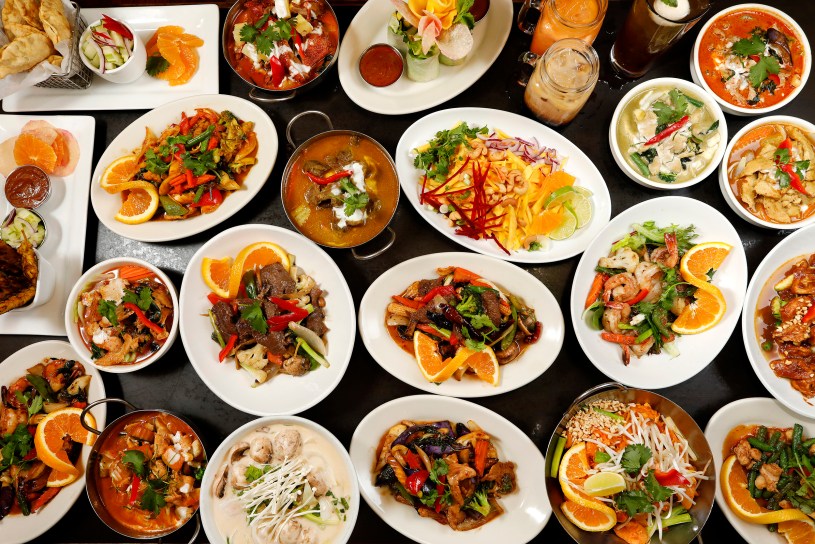
In Asia, indeed, this is the case. Extraordinary dishes come out of the kitchens of many Asian countries. A variety (and goodness!) From which one can only be conquered. What are you waiting for to take the first plane and go and try one of these incredible recipes?
1. BAKSO – INDONESIA
A favorite of Indonesian students, this noodle soup flavored with meatballs (chicken, beef, pork or all three together depending on your taste) and garnished with fried shallots, boiled eggs, and a wonton is a real foundation of Southeast Asian cuisine, where it is sold mostly by carts called ‘kaki lima’. If Barack Obama also remembered this dish as one of the best moments to visit Jakarta, we can only trust it, right?
2. NASI DAGANG – MALAYSIA
In Malaysia, no meal is complete without the famous Nasi Dagang, steamed rice with coconut milk, fish curry, and other ingredients, including fried coconut flakes, boiled eggs, and pickles. The dish is particularly popular in the Kuala Terengganu district on the east coast, but it can be found everywhere throughout the peninsula, served on a banana leaf, especially at breakfast. Who wouldn’t start the day like that, if you think about it?
3. NAAN BREAD – INDIA
Who said that bread is only an accompaniment? I do not agree in India, a country in which it is understood as a real dish: flattened shape and consistency, which has little to do with our loaf, mean that naan can in all respects replace the dish of scope. For goodness, which sometimes surpasses it: incredibly soft, tasty, and with an aftertaste of milk or yogurt, ingredients with which the dough is usually made, this type of leavened bread is addictive to so much it is good. Cooked in the tandoor, the characteristic inverted bell-shaped clay ovens, the naan is then served hot and greased with butter. Are you ready to reevaluate the power of complex carbohydrates?
4. OKONOMIYAKI – JAPAN
If you are a fan of Ranma ½ and Kiss me Licia manga, the okonomiyaki is a must. Otherwise, you will have to taste it, if only to understand why the cat Giuliano (the manga character in the Italian version called him ‘meatballs’) was so greedy. Street food dish born in Osaka, okonomiyaki, has often been compared to a ‘pizza’, but if we had to compare it to some Italian dish, it could be closer to a sort of mega omelet. The salty pancake of which the base is made is cooked on teppan, the special plate, together with all the goodness: slices of cabbage leaves, flour, and eggs, but also pork belly, shrimp and, in the vegetarian version, spinach and cheese. The dish is then garnished with okonomi sauce, bonito flakes, and green seaweed flakes. Now, do you understand why, at least in comics, some can’t do without it?
5. RAMEN – JAPAN
Since the early 1900s, when it was only popular in China and sold in street kiosks that advertised it to the sound of shouts and notes coming from musical horns, street ramen has made it. Not only did it establish itself in Japan, shortly after the second world championship, but it also arrived in the old and the new continent, becoming the alternative to the various sushi and sashimi for true ‘connoisseurs’. The versions of this dish from the working class, which is nothing more than a bowl of long pasta dipped in broth and accompanied by various other ingredients, are practically endless and include variations for each element: the noodles come in various shapes and lengths, the broth can be chicken or pork, and the accompaniments range from beef bones to seaweed to mushrooms and fish. Everything is then flavored with miso and soy sauce. In Japan, they are so crazy that they have even opened a ramen museum, but there is no shortage of Italy fans: are you among them?
6. BALUT – PHILIPPINES, CAMBODIA, VIETNAM
Asian foods, as we know, often make Westerners turn up their noses. One of these is certainly the balut, a typical dish of many Southeast Asian countries, consisting of a fertilized duck or chicken egg boiled in its shell just before it hatches. Don’t make that face! In those areas, it is considered a real delicacy, a very powerful aphrodisiac, and is increasingly found on the menus of luxury restaurants. Balut – from the Filipino, the language in which it means ‘wrapped’ – is nothing more than a chick embryo not yet fully developed and accompanied, depending on the country, by salt, pepper, lemon juice, and mint leaves. If it reminds you of one of the most distressing episodes of ‘Hell’s Kitchen’, don’t go too far: balut, at least in the imagination, is part of the so-called’ nightmare ‘dishes, despite the fact that many swear that it is delicious.
7. SAMOSA – MYANMAR
Famous dishes, especially in the Indian tradition, samosas also occupy an important role in other countries’ kitchens. For example, in Burma, otherwise known as Myanamar, where although the main ingredient continues to be rice and the national dish – mohinga – is based on catfish broth, these spicy pasta bundles stuffed with potatoes and peas and then fried are a great success. Here, they call them ‘samosa’, and they are flatter, smaller, and thinner in shape than their Indian ‘sisters’, but they are also much crunchier. Street foodpar excellence, the ‘samosa’ is sold on every street corner and served in coffee shops in the form of soup or salad, in which the delicious triangles are interspersed with peas, cabbage, and tomatoes. Are you curious to try this alternative version?
8. CENTENARY EGG – CHINA
Who said that, after their expiry date, eggs could not be consumed? They don’t think so in China and insignificant parts of Southeast Asia. They have rendered the pidàn, or ‘centennial egg,’ a national dish. For instance, the egg is not 100 years old, but it already has 100 days, around three months. It’s the period that duck eggs are kept in a pack with the most varied pieces – from ash to salt, clay, and RI.
9. AIS KACANG – SINGAPORE
Asian cuisine is known to be quite spicy. How to put out the flames after a meal in which you certainly didn’t save on chili? In Singapore, they have no doubts: with Ais Kacang, or ABC – an acronym for Air Batu Campur, literally “ ice mix ” – as it is sometimes called. We are talking about a kind of colored granita with different syrups prepared with bizarre-looking ingredients, including sweet corn, red beans, jelly cubes, and palm seeds. At first sight strange, we said, the taste is instead an explosion of flavor and freshness, also excellent for contrasting the humid heat of those areas.
10. DURIAN – THAILAND
Etymologically, it means ‘thorny fruit’, but for everyone (or almost), it is ‘the stinking fruit’, due to its not exactly pleasant smell. Despite this ‘small’ flaw, the fruit – which resembles a sort of giant melon with spikes – is highly prized throughout Southeast Asia, even known as the ‘king of fruits’. The taste seems to be pleasant, but the smell is repellent according to many, so much so that in Singapore and Thailand, the authorities have even banned durian use on public transport. But, armed with a clip in the nose, you could avoid this problem and taste its pulp, according to some very sweet. It is also said to be aphrodisiac: what do you say, will it be worth a try?
Read more interesting best health food blog on Continental Cuisine Chefs.
 Tech Strike